How Long to Stay in a Sauna (Huberman and Rhonda Patrick Protocols)
Sauna Assistant App
Let the sauna tell you when the round is over
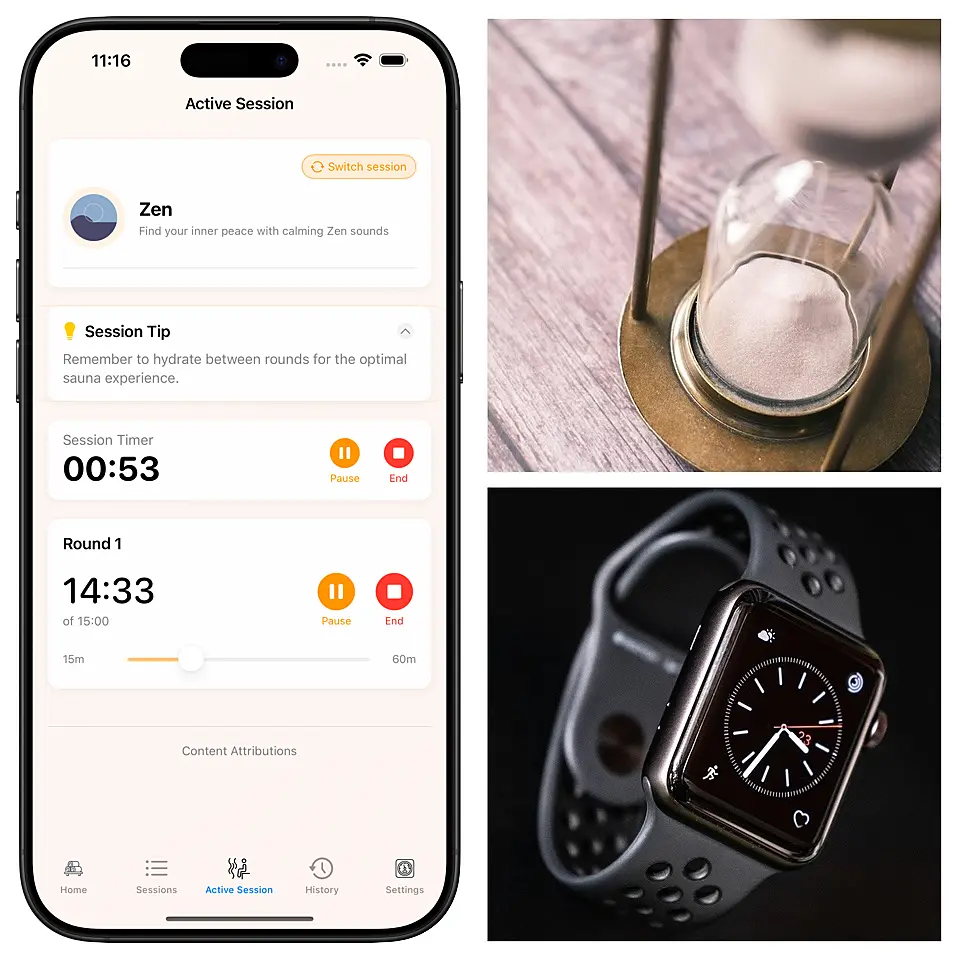
Set your rounds and cool-downs once. Sauna Assistant plays the cues through your sauna's speakers, so you can stay present instead of watching a clock.

Pay once. No subscription.
Sauna rounds commonly last 5 to 20 minutes, with cooling breaks between them. That range is not a safe limit for everyone. If you are new, keep your first visit brief and leave sooner if the heat feels uncomfortable. In the Finnish study often cited by Andrew Huberman and Rhonda Patrick, the men reported averages of 14.2 minutes per session, 78.9°C (174°F), and 2.1 sessions a week.
Below is what those protocols say and what the studies behind them found. The research describes groups of people; it does not establish how long an individual can safely stay.
In This Guide
- How long to stay in a sauna at a glance
- How long per round
- Huberman’s sauna protocol
- Rhonda Patrick’s sauna protocol
- What the Finnish sauna studies found
- The “57 minutes a week” number
- How often should you use a sauna?
- How long is too long?
- Steam rooms and infrared saunas
- Timing it without watching the clock
- Frequently asked questions
How long to stay in a sauna at a glance
| Who or what | Duration | Rounds or sessions |
|---|---|---|
| First sessions | 5-10 minutes | 1-2 rounds, lower bench |
| Regular sauna-goers | 10-20 minutes | 2-3 rounds with cool-downs |
| Huberman, general health | 1 hour a week in total | Split into 2-3 sessions |
| Huberman, heart health | 5-20 minutes | 2-3 times a week, up to 7 |
| Rhonda Patrick | About 20 minutes | At least 4 times a week |
| Finnish study (KIHD), observed averages | 14.2 minutes per session | 2.1 sessions a week; not a prescribed schedule |
The protocol summaries below concern hot Finnish-style saunas. Time alone does not describe heat exposure: temperature, humidity and bench height also matter. Our guide to how hot a sauna is covers those differences.
This guide is general information, not medical advice. If you are pregnant, have a heart condition or take medication that affects blood pressure, ask your doctor before following any sauna protocol.
How long per round
Your first few sessions: 5 to 10 minutes, on the lower bench, then step out and cool down. One or two rounds is plenty. You are teaching your body to handle the heat, and that takes a few weeks of regular visits.
Once you are used to it: 10 to 20 minutes a round, two or three rounds, with a cool-down of at least as long as the round in between. That is close to the traditional Finnish pattern, which Rhonda Patrick’s FoundMyFitness describes as one to three sessions of 5 to 20 minutes, interspersed with cooling.
Leave earlier whenever you want to. The clock is a guide, not a target. Dizziness, nausea, a headache or a pounding heart all mean the round is over, whatever the timer says.
Huberman’s sauna protocol
Andrew Huberman, a neuroscientist at Stanford, covered deliberate heat exposure in episode 69 of the Huberman Lab podcast and summarised three protocols in his newsletter on the topic. All three assume a sauna at 80-100°C (176-212°F), adjusted to your own tolerance:
- For cardiovascular health: 5 to 20 minutes per session, 2 to 3 times a week, or as often as 7 times a week. He notes that more often appears to be better for heart health.
- For general health: about 1 hour of sauna a week in total, split into 2 to 3 sessions rather than one long one. This is the version most people mean by “the Huberman sauna protocol”.
- For growth hormone: he describes four 30-minute sessions in one day, once a week or less. The first two are separated by a five-minute cooling break; the second pair follows several hours later. This is a description of his protocol, not a recommendation to attempt two hours of heat exposure.
He also suggests drinking at least 16 ounces (about 500 ml) of water for every 10 minutes in the sauna, and notes that most infrared saunas do not reach the temperatures these protocols use.
The Huberman Lab materials are explicit that you should not force yourself into an “optimal” protocol from day one, and that you can and should get out whenever you feel unwell.
Rhonda Patrick’s sauna protocol
Rhonda Patrick, a biomedical scientist who runs FoundMyFitness, bases her guidance on the Finnish Kuopio studies (below). As summarised on Huberman Lab, she describes four sauna sessions a week of about 20 minutes each as a good minimum effective dose for supporting cardiovascular health.
The original Finnish study reported a mean sauna temperature of 78.9°C (174°F), not a minimum. It grouped durations as less than 11 minutes, 11 to 19 minutes, and more than 19 minutes. The longest group had a lower observed risk of sudden cardiac death than the shortest group.
These recommendations interpret observational research. The study did not test a minimum effective dose or establish that everyone should work toward 20-minute sessions.
What the Finnish sauna studies found
Most of the numbers above trace back to one long-running study: the Kuopio Ischaemic Heart Disease Risk Factor Study (KIHD) in eastern Finland. In the best-known paper, Laukkanen and colleagues (JAMA Internal Medicine, 2015) followed 2,315 men aged 42 to 60 for about 21 years.
- Frequency: men who used a sauna 4 to 7 times a week had a markedly lower risk of fatal heart events than men who went once a week. Two to three times a week sat in between.
- Duration: compared with sessions shorter than 11 minutes, sessions longer than 19 minutes were linked to a lower risk of sudden cardiac death. Sessions of 11 to 19 minutes showed little difference.
Two caveats matter. The study is observational, so it shows an association rather than proof that the sauna caused the difference. And it included only middle-aged Finnish men, for whom a sauna is a lifelong, everyday habit. The findings are encouraging, but they describe a culture as much as a prescription.
The “57 minutes a week” number
You will often see “11 minutes of cold and 57 minutes of heat a week” quoted as a protocol, usually credited to Danish researcher Susanna Søberg. It comes from her 2021 study of experienced winter swimmers in Copenhagen (Cell Reports Medicine). Those numbers describe what the swimmers in the study typically reported doing each week. They were not tested as an ideal dose.
That average does not establish a weekly target, a minimum effective dose or a safety limit. Its similarity to Huberman’s one-hour recommendation does not validate either number.
How often should you use a sauna?
Two or three times a week is a realistic, sustainable rhythm for most people, and it is where the Finnish studies started to see a difference. Four to seven times a week is where they found the strongest associations, but those men were lifelong daily sauna-goers.
The best frequency is the one you keep up. A sauna you look forward to twice a week will do more for you than a daily protocol you abandon after a fortnight.
How long is too long?
Twenty minutes may be too long depending on the temperature, humidity, your health and your heat tolerance. The longest duration group in the Finnish study was simply “more than 19 minutes”; that category does not establish a safe limit or show that extending a round improves its benefits. Do not treat 20 or 30 minutes as a target to reach.
Leave the sauna if you feel dizzy, sick, faint or unusually tired, or if your heart is racing uncomfortably. Do not use a sauna after drinking alcohol, and drink water before and between rounds. Our sauna hydration guide covers how much.
Confusion is an emergency. Confusion, slurred speech, fainting or a seizure can be signs of heat stroke. Get the person out of the heat, call emergency services (911 in the US, 112 in Europe), and cool them straight away with cold water or wet cloths while you wait. Sweating does not rule it out: someone with heat stroke can still be sweating heavily.
Children follow much shorter rules. See our kids in sauna guide.
Steam rooms and infrared saunas
Steam rooms are cooler, 40-50°C (104-122°F), but the air is close to 100% humidity, so sweat cannot cool you. Most people stay 10 to 15 minutes.
Infrared saunas run at 45-65°C (113-149°F), so sessions often last longer, around 20 to 30 minutes. Huberman points out that most infrared saunas do not reach the temperatures the protocols above are based on, so the research does not transfer one to one.
Timing it without watching the clock
The irony of a sauna protocol is that it can turn a calm ritual into clock-watching. Set the rounds once and let something else keep time:
- Our guide to timing sauna rounds compares sand timers, phone alarms, watches and apps
- The free web sauna timer runs rounds and breaks in any browser
- Sauna Assistant plays the round and cool-down cues through your sauna’s speakers, so your phone stays outside and your eyes can stay closed
For more on the options, see sauna timer apps compared.
Sources
- Andrew Huberman, Deliberate Heat Exposure Protocols for Health & Performance, Huberman Lab newsletter
- Huberman Lab, Sauna and Heat Exposure topic page (summary of Rhonda Patrick’s guidance)
- Rhonda Patrick, Sauna, FoundMyFitness topic page
- Laukkanen T, et al. Association between sauna bathing and fatal cardiovascular and all-cause mortality events. JAMA Internal Medicine, 2015
- Søberg S, et al. Altered brown fat thermoregulation and enhanced cold-induced thermogenesis in young, healthy, winter-swimming men. Cell Reports Medicine, 2021
Frequently asked questions
How long should you stay in a sauna?
Sauna rounds commonly last 5 to 20 minutes, but there is no single duration suitable for everyone. Temperature, humidity, health and heat tolerance all matter. Keep your first visit brief and leave sooner if you feel uncomfortable or unwell.
How long should a beginner stay in a sauna?
Start with 5 to 10 minutes per round, one or two rounds, on the lower bench where it is cooler. Build up gradually over a few weeks of regular visits.
What is the Huberman sauna protocol?
Andrew Huberman’s general health protocol is about 1 hour of sauna a week in total at 80-100°C, split into 2 to 3 sessions. For cardiovascular health he describes 5 to 20 minutes per session, 2 to 3 times a week or up to 7 times a week.
What is Rhonda Patrick’s sauna protocol?
Rhonda Patrick describes about four 20-minute sessions a week in a hot Finnish-style sauna for cardiovascular health. This is her interpretation of observational research, not a minimum effective dose established by a trial.
Is 20 minutes in a sauna too long?
It may be, depending on temperature, humidity, health and heat tolerance. The Finnish study does not establish a safe individual time limit. Leave sooner if you feel uncomfortable or unwell, and do not treat 20 minutes as a target.
How many minutes a week should you sauna?
There is no weekly target established by these studies. Huberman recommends about an hour across several sessions. The 57 minutes reported in Susanna Søberg’s study was an observed average, not a tested optimal dose or safety limit.
How often should you use a sauna?
Two or three times a week is a sustainable start. The Finnish studies linked four to seven sessions a week to the strongest associations, but the best frequency is the one you keep up.